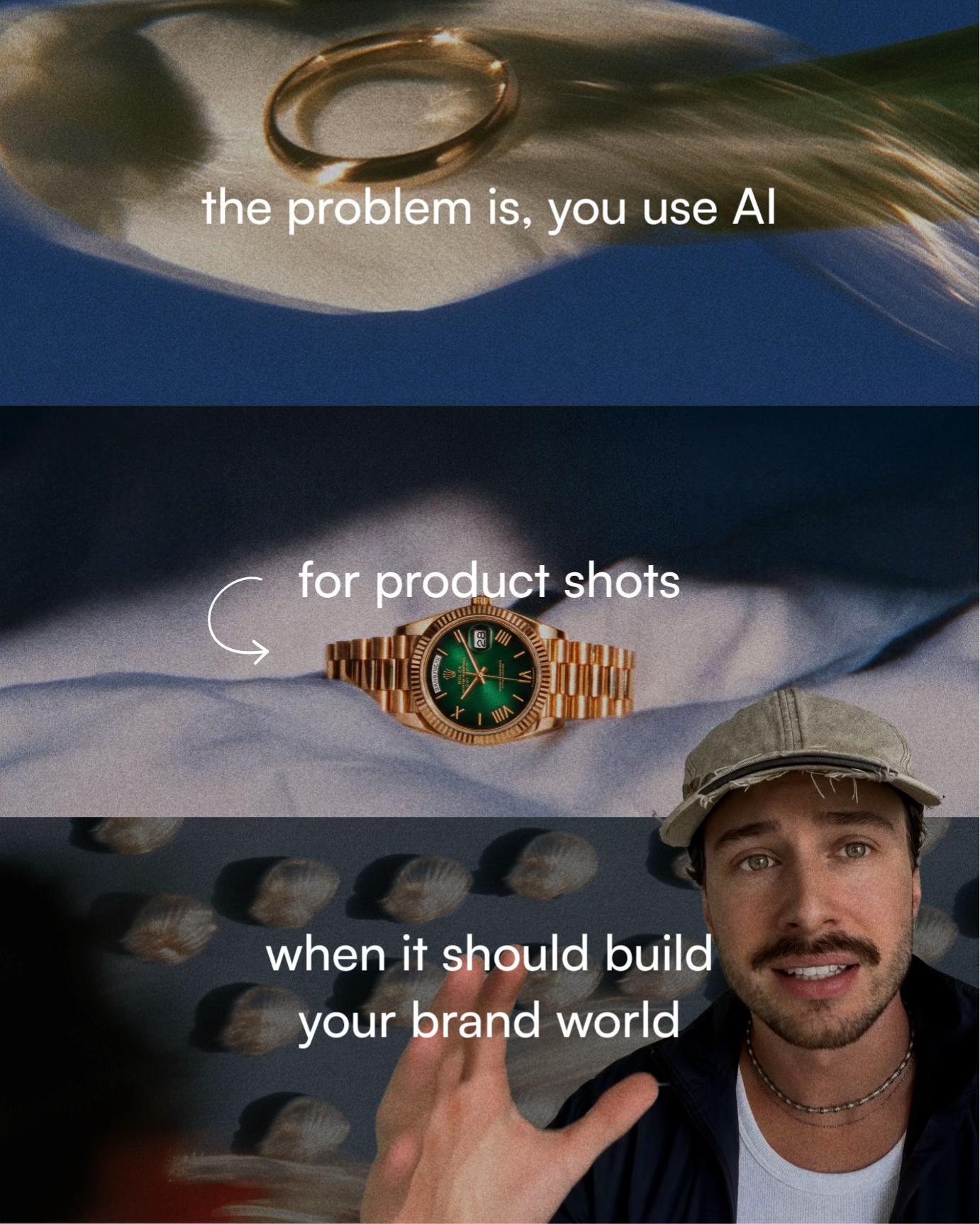
AI product shots: why the best start with human control
Handing everything to an AI model is how you get technically impressive footage that feels like nobody made it.
You have seen the AI product video that looks almost right. The bottle is beautiful, the lighting is cinematic, and something about it still feels off. The mist moves in no particular direction. The camera does something that no one would have chosen. The whole thing reads as a series of technical achievements that no one was steering.
That is not a limitation of the AI. It is a workflow problem.
Control the structure before you hand anything over
For a product reveal, a perfume bottle, say, you do not need to model the final scene in full. What you need is enough structure to make the shot intentional:
A rough proxy shape for the bottle and cap, so the AI knows where the object lives in space.
A basic indication of where the mist moves, so the particle motion reads as designed.
A clear camera move, set in advance, so the reveal has a rhythm someone chose.
The right timing locked before any render begins.
That skeleton is the part that requires human judgement. It is not technically complex. But it is the part where the result either becomes a product ad or stays a demo reel.
Once that structure exists, AI does what it is genuinely good at: the glass refraction, the surface reflections, the soft-focus mist, the kind of lighting finish that would take a full CG pipeline and several days to build from scratch.
What this means when you’re commissioning AI creative work
AI handles the glass, the mist, the reflections. The human controls the shot.
“
AI handles the glass, the mist, the reflections. The human controls the shot.
That sentence is a useful filter for evaluating the AI creative work you are considering buying. A lot of AI product content is generated in the opposite order: prompt the model, adjust until something interesting appears, ship the best result. That process occasionally produces something good. It rarely produces something that looks like your brand made a deliberate choice.
The workflow described above is harder to execute than it looks. It requires someone who understands camera language, knows how to rig a proxy scene, and has enough experience with tools like Seedance to predict how a rough render will be interpreted and finished. That combination of skills, structural thinking plus AI fluency, is not common.
When it is present, the output is different in a way that is immediately obvious. The shot has a point of view. The motion feels authored. The product looks like it was lit by someone who cared about it.
What to ask before you commission a product video
If you are briefing AI creative work for a product launch, two questions separate a practitioner from someone who is still figuring it out:
How do you control the camera move and timing before the AI render begins?
What does your proxy or pre-vis process look like for this kind of shot?
A Promptist who builds product work this way will have clear answers. Someone relying entirely on the model to make decisions will not.
The goal is not to use less AI. The goal is to use AI for the things it is genuinely fast and capable at, while keeping the decisions that determine whether a shot feels intentional firmly in human hands. Less reconstruction, more control, better result.