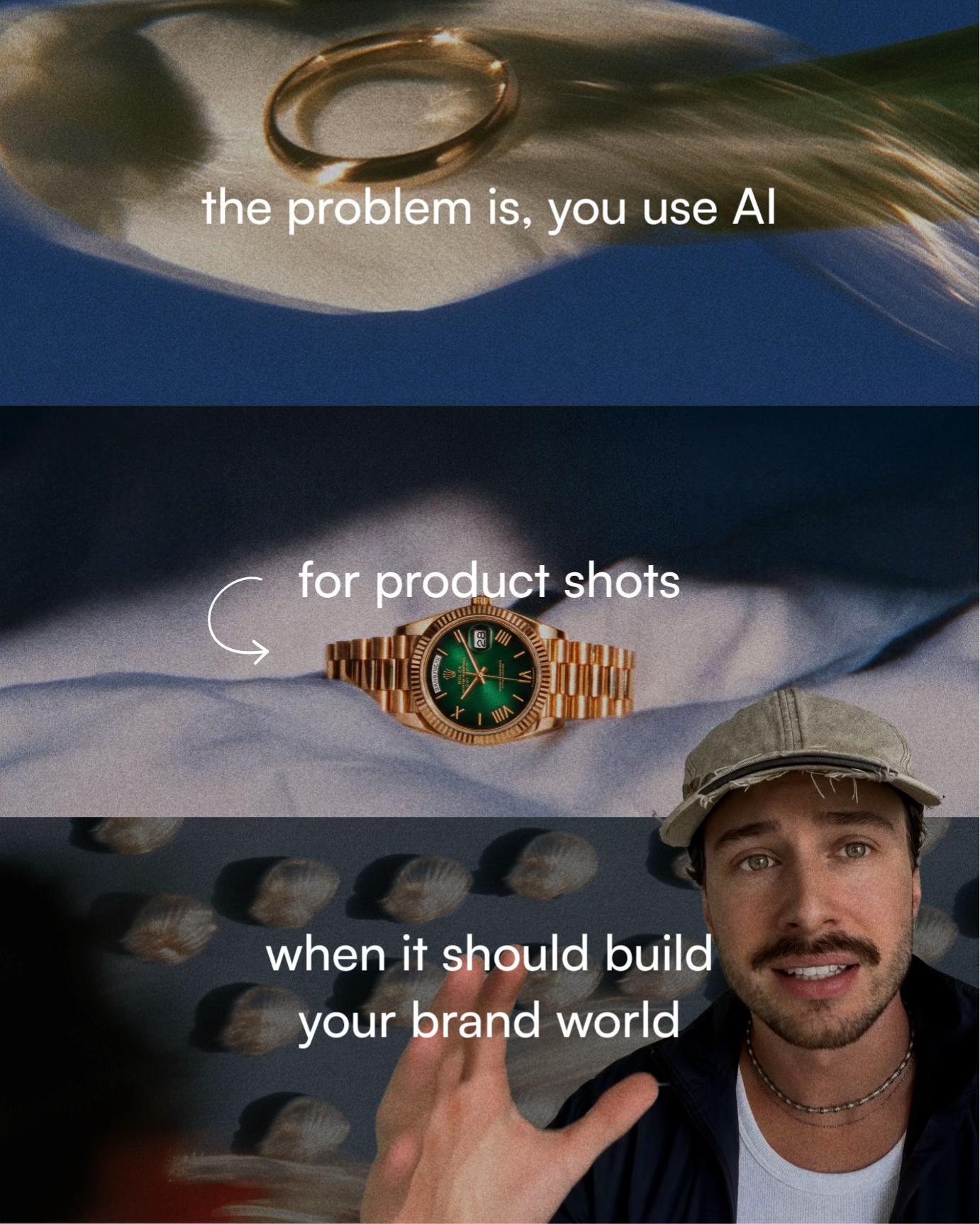
You’ve probably seen at least one AI video clip recently that stopped your scroll. A transition that looked physically impossible, footage that seemed to move through a surface or a lens or a window into another place entirely. Your immediate thought was probably some version of: how did they do that, and could we do that for our brand?
The honest answer is yes. But the more useful answer is: it depends entirely on whether the person making it understood what they were doing, or whether they got lucky once and can’t repeat it.
What the process actually looks like
Here is the specific example worth understanding. A creator took two frames: a real photograph of a camera lens taken on location, and an AI-generated image of what you’d see from inside that lens looking out at the Azores. He dropped both into Gemini and used Veo 3 to generate an animated clip bridging them. Then he reversed the direction: the AI frame became the new start, the real location shot became the new end. Second prompt, second clip. Stitch the two together and you have footage that appears to fly through the lens into a real place.
Two frames. Two prompts. One effect that looks like it required a camera rig, a drone, and a post-production team.
What makes this work is not the tool. Veo 3 is powerful but it doesn’t make editorial decisions. What makes it work is the structural logic:
- The start and end frames are chosen with the transition in mind, not just as standalone images.
- The AI frame is designed to serve as both an end point and a reversible start point.
- The stitch is the actual creative problem being solved, and everything before it is in service of that.
That is a workflow, not a one-off. It can be applied to a product shot, a brand film opener, a campaign asset that needs to feel distinct from anything competitors are doing.
Why most AI video still disappoints
The majority of AI video content that brands are producing right now has a recognisable quality: it looks like a series of experiments. Different visual logic in each clip. Characters that shift between frames. A colour palette that drifts. Transitions that feel random rather than intentional.